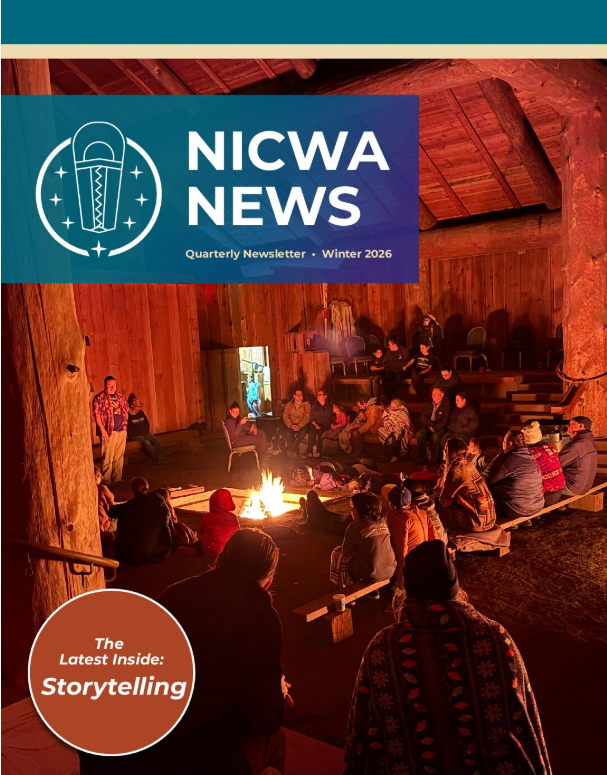
Quarterly Newsletter
“Storytelling”
NICWA News is the quarterly newsletter for members and donors of the National Indian Child Welfare Association. Donate or become a member today to subscribe.
A Message from NICWA’s Executive Director
Dear NICWA Members, Sponsors, Donors, and Friends,
Welcome to the Winter issue of NICWA News. This issue embraces our oral tradition, “Storytelling“.
As you may know, I’m Alutiiq, also known as Sugpiaq. That’s my linguistic and cultural group. In the 1800s, there were more than 60 Alutiiq villages in the Kodiak, Alaska archipelago with an estimated population of 13,000 people. Today there are about 4,000 Alutiiq people living in 15 rural villages, five towns, and in major cities. We’ve lived in our traditional homelands for more than 7,500 years. My family is from a village called Ouzinkie.
Because colonization—first Russian and then American—suppressed transmission of culture and identity, traditional storytelling is important to Alutiiq people. It connects us to our families and our core values, building a strong sense of identity and well-being.
Much of what we know today about Alutiiq storytelling traditions has been published in a doctoral dissertation by Dr. Alisha Drabeck (2012), so I want to acknowledge her work. Drabeck writes,
“Storytelling as a traditional vehicle for knowledge acquisition is multifaceted and offers a richness in learning that is difficult to surpass. Shared stories build a common experience; develop the art of listening and symbol association; foster social skills and an understanding of human motives and patterns of behavior; invoke a physical response through language; prepare us for life through experiential connections; transmit cultural traditions; strengthen identity and demonstrate ‘right’ behavior within values. All of these complex lessons and more can be conveyed through a simple story passed down from generation to generation” (p.14).
At NICWA, we see the impact of storytelling in our daily work, from rallying advocates to ensuring training lessons stick long after the class. Whenever a child welfare worker or a family going through the system shares their experience with us, we are reminded of the power of storytelling, which helps us empathize, connect, and relate. In Drabeck’s writing, she goes on to say,
“Across millennia, stories convey their lessons and have sustained generations as they are retold and become integrated into our minds as a means of interpreting and comparing our experiences to what we’ve been told through story. Storytelling is a powerful learning tool that links us to our ancestors” (p.14).
And finally, “Ancestrally and contemporarily, storytelling is done to perpetuate life, convey values and a worldview, as well as heal from and honor past hardships. Asserting who we are as a people, how we see the world and what matters to us most is the job of storytelling” (p.15).
In this issue of NICWA News, you can read stories written by a variety of NICWA staff about our inspiration and recent work—and the people and places that have played a role in it.
Drabeck says, “Storytelling can become a healing process, both for storytellers and their audience, reinforcing our sense of identity and belonging to our identifying group ― building unity, wellbeing and a sense of purpose or meaning to life” (p.15). We hope that by telling our stories, you feel a sense of belonging to our community through our shared purpose as advocates.
With gratitude,
Sarah L. Kastelic, PhD
(Alutiiq)